


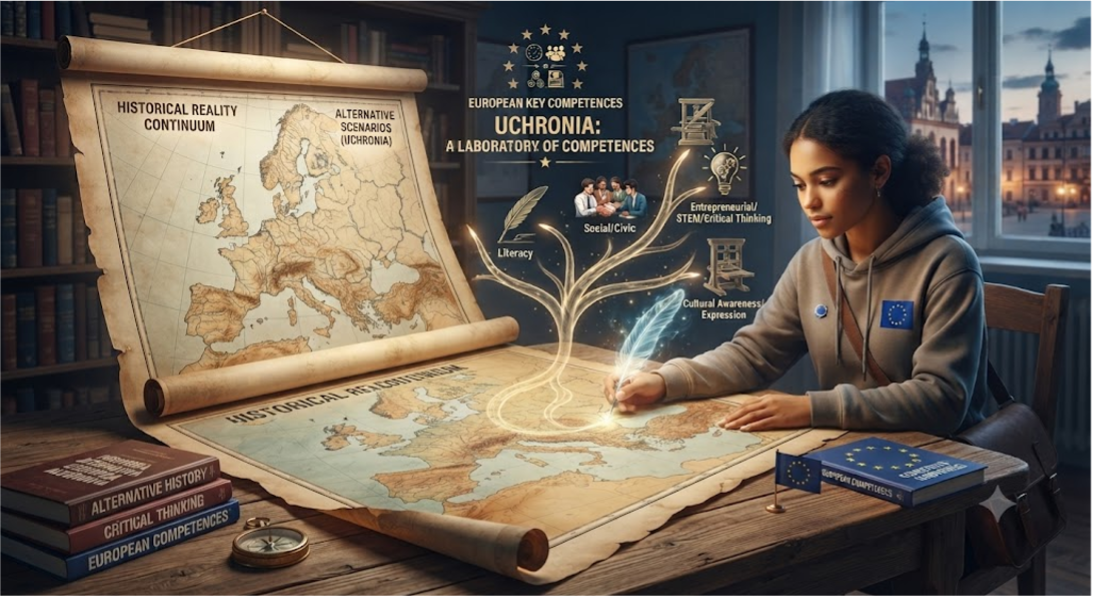
This article explores the pedagogical potential of uchronia, the literature and exercise of alternative history, as an innovative didactic method for developing European key competences (in accordance with the 2018 Council Recommendation). By analyzing educational environment feedback, it is demonstrated that "what if" exercises stimulate not only critical thinking and civic skills but also interpersonal and active learning competences, transforming history study into a laboratory for reflecting on responsibility and causality.
In a society marked by rapid change, European education emphasizes the formation of transferable competences necessary for lifelong learning. The Council Recommendation of May 22, 2018, defines eight key competences essential for social inclusion and personal development, including literacy, civic, entrepreneurial, and personal competences. In this framework, uchronia, defined as the exploration of alternative historical scenarios, transcends the sphere of fiction, becoming a didactic instrument that places the student in an active research situation.
Uchronia as a method for developing key competences
The analysis of learning experiences based on uchronia reveals a direct correlation between alternative historical exercises and the European training profile:
- Critical thinking and literacy: The use of uchronia compels students to analyze the causality of historical events, moving beyond passive memorization. The capacity to formulate hypotheses and compare reality with alternative scenarios strengthens logical thinking and media discernment.
- Civic and social competences: Teamwork in constructing an alternative narrative develops skills in collaboration, active listening, and respect for divergent opinions. Uchronia facilitates the understanding of the responsibility behind political and historical decisions, thereby consolidating democratic culture.
- Personal and entrepreneurial competences: Active involvement in shaping alternative universes stimulates creativity and initiative. Students report a high level of motivation, arguing that uchronia is more engaging than traditional methods, which supports "learning to learn" as a continuous process.
Practical applications of uchronia
To deepen the role of uchronia in developing European key competences, we analyze how practical exercises translate into concrete learning experiences, transforming the curriculum from abstract to applied.
1. Developing critical thinking and literacy (STEM + civic)
Uchronia functions as an exercise in causal analysis. Instead of merely memorizing dates and names, students become "architects" of history.
Concrete example: During a lesson on World War II, the teacher may propose the scenario: "What would have happened if the Axis powers had won the Battle of Stalingrad?"
Impact: Students do not just imagine a scenario; they must analyze logistical resources (STEM competence - systemic thinking), geographical positions, and long-term political implications (civic competence). This process forces them to identify the determinants of real history, understanding that events are not inevitable, but the result of specific decisions.
2. Strengthening personal, social, and "learning to learn" competences
Teamwork in uchronia projects shifts the focus from individual competition to co-creation.
Concrete example: Creating a "News Journal from an alternative world" (e.g., A world where the Roman Empire never fell). Students divide roles: some are "researchers" documenting ancient technology, others are "editors" writing the news.
Impact: This activity requires negotiating opinions ("Is it realistic for the Romans to have invented electricity in the 5th century?"). Students learn to express their ideas freely, listen to colleagues' arguments, and respect different viewpoints, developing social intelligence and self-regulation capacity (learning to learn).
3. Stimulating entrepreneurial competences and creativity
Entrepreneurial competence involves the capacity to identify opportunities and take risks in formulating one's own hypotheses.
Concrete example: "The Historical Leader Role-Play." Students are placed in the position of a past political leader (e.g., Alexandru Ioan Cuza) facing a national crisis. They must formulate alternative solutions to the decisions taken at the time.
Impact: The student ceases to be a passive recipient and becomes a problem solver. This exercise develops the courage to propose new ideas, the ability to anticipate consequences, and perseverance in completing a coherent narrative, grounding a spirit of initiative.
Synoptic table: From theory to practice european competence concrete uchronia
| European competence | Concrete uchronia activity | Expected result |
| Critical thinking | Analysis of the "Domino Effect" in key historical events. | Understanding causal complexity. |
| Civic debate | "What would human rights look like in a world without the French Revolution?" | Awareness of current democratic values. |
| Entrepreneurial | "Pitching" an alternative historical strategy (e.g., avoiding an economic crisis). | Development of argumentation and risk-taking. |
| Cultural | Drafting fictional letters from different cultural perspectives. | Development of empathy and respect for diversity. |
Uchronia is not merely an exercise in imagination, but a transdisciplinary learning method that facilitates the achievement of European competence standards. By pushing the limits of "real" history, students learn to take intellectual risks, work collaboratively, and understand the complexity of the contemporary world. Integrating this instrument into modern didactics is an efficient way to transform the learner into an active citizen, capable of critical reflection and social responsibility.
Bibliography
Council of the European Union (2018). Council Recommendation of 22 May 2018 on key competences for lifelong learning (2018/C 189/01).
EuroClio (2019). Innovative teaching approaches: Multiperspectivity in history teaching.
Ionescu, M., & Chiș, V. (2001). Didactica modernă, Editura Dacia.
Fundatia EuroEd (2020). Metode inovative și interactive de lucru cu elevii, Proiect POCU D.E.D.I.C.A.T..
Hattie, J. (2014). Visible Learning: A Synthesis of Over 800 Meta-Analyses Relating to Achievement, Routledge (originally published as Învățarea vizibilă).
Wineburg, S. (2001). Historical Thinking and Other Unnatural Acts: Charting the Future of Teaching the Past, Temple University Press.