


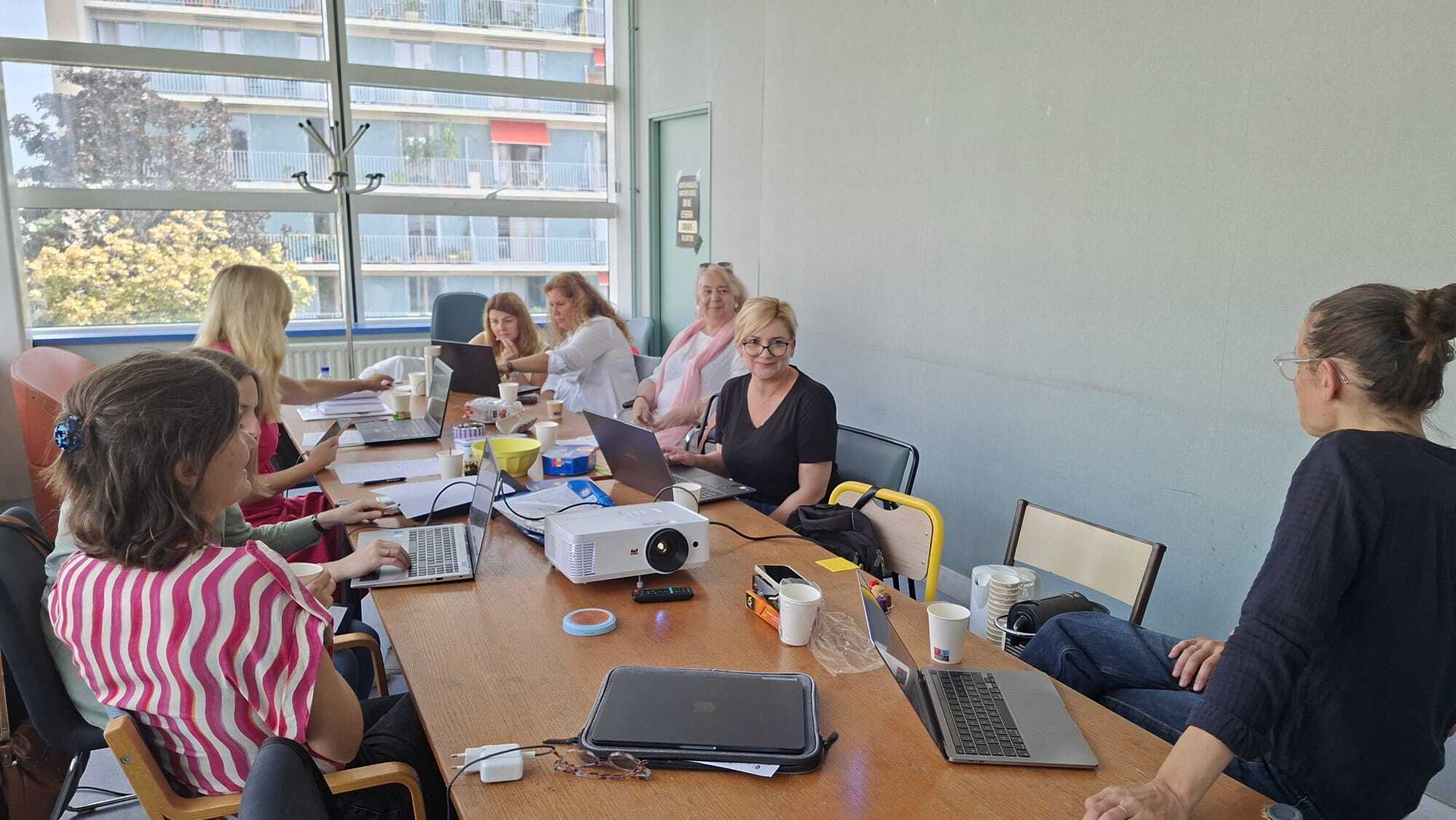
From 1 to 3 September 2026, the partners of the European project Reframe the Story gathered in Paris, hosted by Les Apprimeurs at Césure, for three days of transnational meetings and training. The programme included testing the “Mission Moon” prototype, exploring different gameplay mechanics and sharing perspectives on history teaching across Europe.
How can games help pupils learn to question historical accounts? This question guided our discussions and workshops in Paris. By sharing our practices and experimenting together, we continued developing the project’s narrative boxes: activities that invite pupils to investigate, explore alternative historical scenarios and consider different perspectives.
“Mission Moon”: investigating and questioning sources
Testing the “Mission Moon” prototype brought these reflections to life. The activity invites pupils to examine documents, assess their reliability, cross-check information and justify their choices.
Trying the prototype together helped us discuss the relationship between game rules and intended learning outcomes. What clues should pupils receive? How can we support their analysis of documents? What background knowledge do they need before starting?
The discussions highlighted the value of preparatory activities on identifying sources and recognising misinformation. The aim is to give pupils the tools to develop reasoned arguments and explain the evidence behind their conclusions.
Gameplay mechanics linked to specific skills
Beyond “Mission Moon”, we explored several ways to connect storytelling, gameplay and history learning. Three main approaches emerged:
- Investigating sources, by comparing documents and supporting conclusions with evidence.
- Understanding causes and consequences, by exploring how changing one event can trigger a chain of further changes.
- Changing perspectives, through role play and contrasting accounts that show how different people can experience the same event.
These discussions confirmed a shared design principle: each box will combine a historical topic, a main gameplay mechanic and an explicit learning competence.
Particular attention was also given to distinguishing between established facts, plausible alternatives and speculation. To explore how history might have unfolded differently, pupils will need solid historical knowledge and appropriate support, such as cards, timelines, prompts or examples of possible consequences.
Sharing perspectives on history teaching across Europe
The meeting also provided an opportunity to compare our educational contexts and approaches to history teaching in the partner countries. Curricula, pupils’ ages and needs, and classroom conditions all shape how activities should be designed.
These exchanges support a shared ambition: to create resources that can be used across countries while remaining adaptable to local contexts. The boxes will therefore follow a common structure, with pupil materials and teacher guidance. Each box will target a specific age group within an overall range of 8–15 years.
Accessibility and support for pupils with special educational needs were also central to our discussions, with the aim of enabling everyone to participate.
Extending the discussions through immersion
A visit to the Cité de l’Histoire extended our collaborative work. It prompted further discussions about traces of the past, historical evidence and the choices involved in presenting history through immersive storytelling. These reflections will inform how we connect narrative experiences, diverse perspectives and historical understanding.
The three days established further foundations for developing at least five narrative boxes, one per partner. The ideas explored in Paris will be developed further with teachers, then evaluated and tested before classroom implementation.