


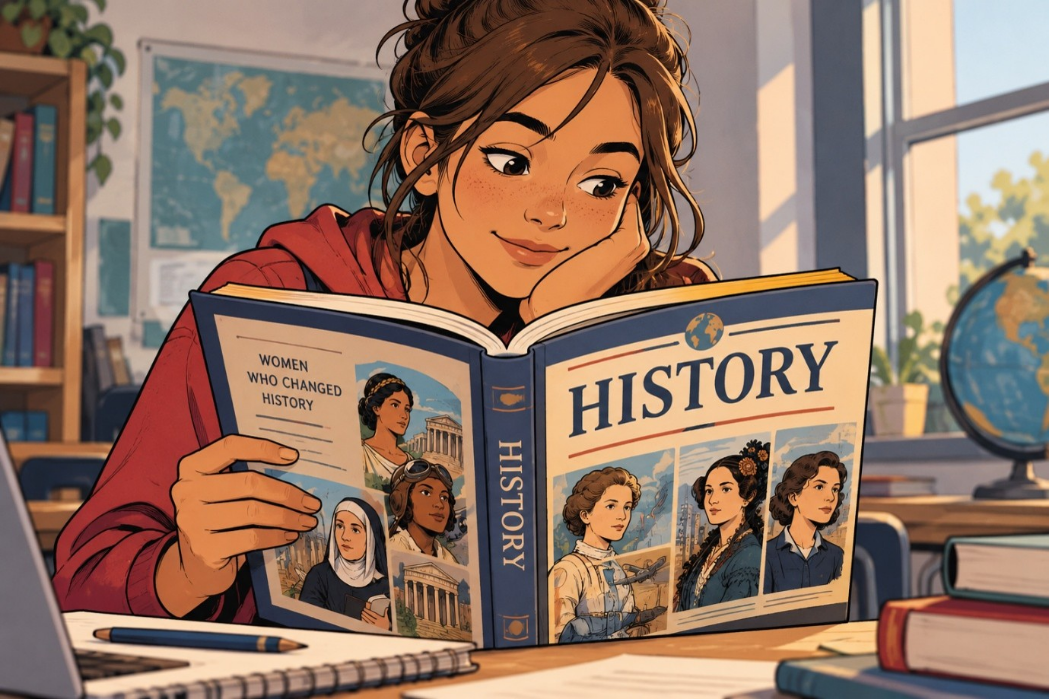
Imagine opening a history textbook and finding women not as occasional exceptions, but as scientists, explorers, artists, political thinkers and decision-makers shaping the world. Would we understand our past differently? And would we imagine our future the same way?
The stories we tell shape the world we see
Think back to the history lessons you had at school. Which names come to your mind? Perhaps kings, generals, inventors, philosophers or political leaders. Now try to remember how many women you learned about in those same lessons.
Women have always been part of history, but their contributions have not always received the same recognition as men's. When women do appear, they may be presented as exceptions, supporting characters in someone else's story, or figures whose achievements are reduced to their relationships with famous men.
This absence is not only a matter of missing names. The stories we learn influence whose achievements we value and who we imagine capable of changing the world.
But what if this had been different?
Katherine Johnson: the mathematician who helped reach the stars
In 1953, African American mathematician Katherine Johnson joined the National Advisory Committee for Aeronautics (NACA), the organisation that preceded NASA. She worked in a period when racial segregation and gender discrimination limited the opportunities available to Black women.
Johnson's mathematical skills proved to be essential to America's early space missions. She calculated the trajectory of Alan Shepard's 1961 spaceflight and verified the orbital calculations for John Glenn's 1962 mission. Glenn famously requested that Johnson check the electronic computer's calculations before trusting them for his flight around Earth.
Although her expertise was valued by colleagues, her story remained largely unknown to the wider public for decades. It reached a much broader audience with the publication of “Hidden Figures” in 2016 and the film that followed.
But Katherine Johnson’s story is one among many others. We can wonder how history might have unfolded differently if the achievements of women like her had always been recognised and celebrated.
What if recognition had been equal?
Imagine an alternative past in which women scientists had consistently received the same recognition as their male colleagues. Their names would have appeared in textbooks, their discoveries would have been celebrated, and their portraits might have hung in classrooms for generations.
Would more girls have grown up seeing science as a place where they belonged? Would more families, schools and institutions have encouraged them to pursue careers in science? Could a more diverse scientific community have influenced the questions researchers asked and the problems they chose to solve?
These questions lead us into uchronia: the exploration of an alternative version of history based on a change to something that really happened.
We do not need to invent extraordinary events or imagine a completely different world. Instead, we can start with a documented fact: women have made important contributions to science, yet their achievements have often been overlooked or credited to others. We can then change one element of the story: what if recognition had been equal?
From there, we can explore possible consequences. Greater visibility might have provided more role models for future generations. This could have challenged stereotypes about who is naturally suited to scientific work. Over time, it might have influenced educational choices, recruitment practices and public expectations.
Of course, equal recognition would not automatically have eliminated discrimination. Access to education, economic opportunities, social expectations and institutional barriers would still have mattered. This is precisely what makes the exercise interesting: it invites us to examine the many factors that shape historical change rather than assuming that one decision can transform everything.
From the past to the possibilities of tomorrow
The same questions can be asked about women in politics, art, literature and social movements. What if their ideas had been taken seriously earlier? What if their work had been documented as carefully as that of their male contemporaries? Whose contributions are still missing from the stories we tell today?
In the classroom, the students could explore the life of a historical woman whose contribution has received limited attention. After researching her achievements and the context in which she lived, they could imagine how her story might have unfolded if she had enjoyed the same recognition, resources or opportunities as her male counterparts. Students could then trace possible consequences, support their ideas with historical evidence and consider alternative explanations.
This exercise combines historical research, creative thinking and reflection on equality without confusing imagined outcomes with established facts.
In the end, asking “what if” is not about wishing the past had been different. It is about understanding why it unfolded as it did, recognising the people who shaped it, and questioning the assumptions that still influence our view of the world.
Because the stories we choose to tell about yesterday can influence the possibilities we imagine for tomorrow.
Sources
- NASA, Katherine Johnson Biography. A detailed account of her mathematical contributions and career.
- U.S. National Park Service, Places of Hidden Figures: Black Women Mathematicians in Aeronautics and the Space Race. Historical context on the racial and gender barriers faced by Black women working in aeronautics.
- UNESCO, Global Education Monitoring Report 2020: Gender Report. Research on gender equality and the representation of women in education.