


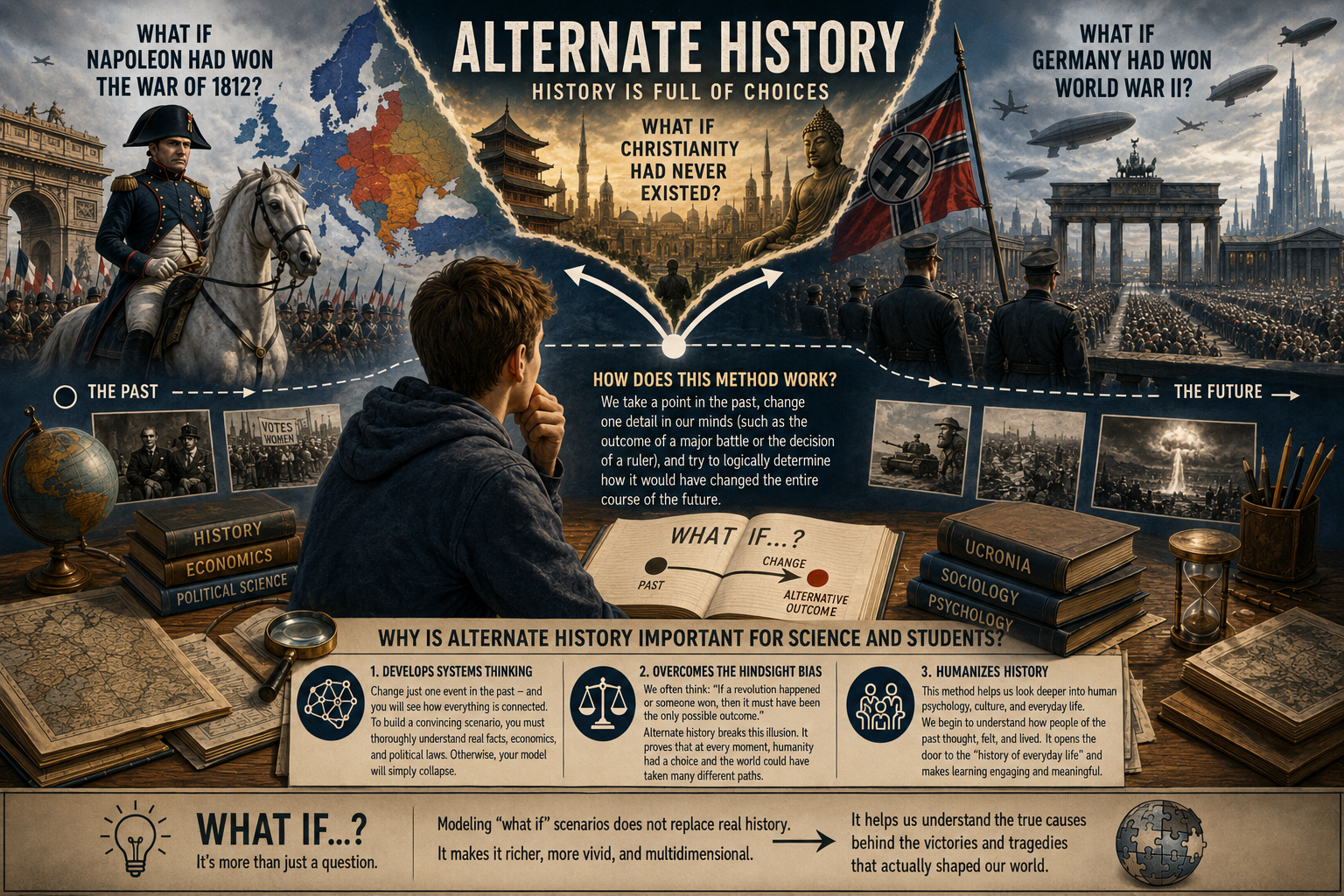
Each of us has asked at least once in our lives: What would have happened if…? What would have happened if Napoleon had won the war of 1812, if Christianity had never emerged, or if Germany had won the Second World War? For a long time, academic scholars considered such questions meaningless. It was believed that the past was completely linear, irreversible, and that all events in it had already been predetermined.
However, times have changed. Today, alternative history (also known as uchronia) has moved beyond the boundaries of science fiction novels. Scientists and educators have recognized it as a serious scientific method known by the complex term retrospective forecasting. Simply put, it is the modeling of the past according to the principle of what if…?
Alternative history is one of the most diverse genres of speculative fiction. There are countless possible causes and points in time where an imagined world can diverge from reality, offering vast space for an author’s creativity and an almost endless number of potential storylines. Some alternative history worlds remain close to reality and involve only minimal fictional assumptions, while others are so original and imaginative that they invite deeper exploration.
This approach forms the basis of the Reframe the Story project, which aims to help students and teachers explore history through alternative narratives and participatory learning. By encouraging students to rethink historical events and question dominant interpretations, the project promotes critical thinking, inclusion, and more active engagement in education.
How does this method work?
In everyday life, forecasting is an attempt to predict the future based on what we have today. In alternative history, everything works in the opposite way: we take a point in the past, mentally change one detail there (for example, the outcome of an important battle or the decision of a ruler), and then try to logically determine how that change would have affected the entire course of subsequent world history.
Within Reframe the Story, students become active creators of such scenarios. Instead of simply memorizing facts, they participate in collaborative activities and discussions that encourage them to co-create alternative historical realities and examine how small changes can lead to major consequences.
Why is alternative history useful for science and students?
It may seem pointless to spend time on things that never actually happened. In reality, counterfactual modeling develops thinking much more effectively than simply memorizing textbook chapters. It has three main “superpowers”.
Developing systems thinking
Try changing even a single event in the past. You immediately realize that history is an extremely complex living organism in which everything is interconnected. Changing one detail instantly triggers an avalanche of consequences. To create a convincing alternative scenario, a student must thoroughly understand real historical facts as well as the laws of economics and politics; otherwise, the model would simply collapse.
Projects such as Reframe the Story use this principle to strengthen students’ analytical and collaborative skills through interactive learning experiences.
Overcoming hindsight bias
We often think: “If a revolution happened or someone won, then it means things could not have turned out differently.” This is a dangerous illusion. It leads us to believe that people in the past were merely pawns in the hands of fate. Alternative history removes this distortion. It demonstrates that at every point in time humanity had choices, and the world could have followed dozens of different paths.
By challenging fixed narratives and historical biases, Reframe the Story helps students understand that history is not only about outcomes but also about choices, perspectives, and human agency.
Humanizing history
Ordinary textbooks are often overloaded with dry numbers, economic charts, and large-scale processes. The method of uchronia forces us to come down to earth and look into human psychology. We begin to think about what a particular military commander felt before making a decision, what everyday culture of that era was like, and how ordinary people lived. This opens the door to the history of everyday life, making learning genuinely interesting and relatable.
This human-centered perspective also supports one of the goals of Reframe the Story: creating more inclusive learning environments where different voices and experiences can be explored and discussed.
The conclusion is simple: modeling “what if…” scenarios does not replace real history; rather, it makes it richer, more vivid, and multidimensional. This approach helps us gain a deeper understanding of the true causes behind the victories and tragedies that actually shaped our world. Through Reframe the Story, alternative narratives become not only a tool for studying the past but also a way to develop critical thinking, participation, and meaningful learning for the future.
Sources used:
- Bocharov A. B. Alternativnaya istoriya kak sposob modelirovaniya/upravleniya istoricheskoy deystvitelnostyu (opyt sistemnogo analiza) // Upravlencheskoe konsultirovanie. 2000, Lk 167-174.
- Davydov A. I. Alternativnaya istoriya: metodologicheskie vozmozhnosti // Sibirskiy gosudarstvennyy universitet putey soobshcheniya. 2015. Nr 2., Lk 88-93.
- Samylov O. V. «Alternativnaya istoriya» i klassicheskaya interpretatsiya printsipa istorizma // Sankt-Peterburgskiy gosudarstvennyy universitet servisa i ekonomiki. Lk 1-14.
- Tkachenko N. A. Istoriya v soslagatelnom naklonenii: opyt alternativnoy istorii // Uchenye zapiski Tavricheskogo natsionalnogo universitema im. V.I. Vernadskogo. Seriya «Filosofiya. Kulturologiya. Politologiya. Sotsiologiya». 2014, Lk 167-174.